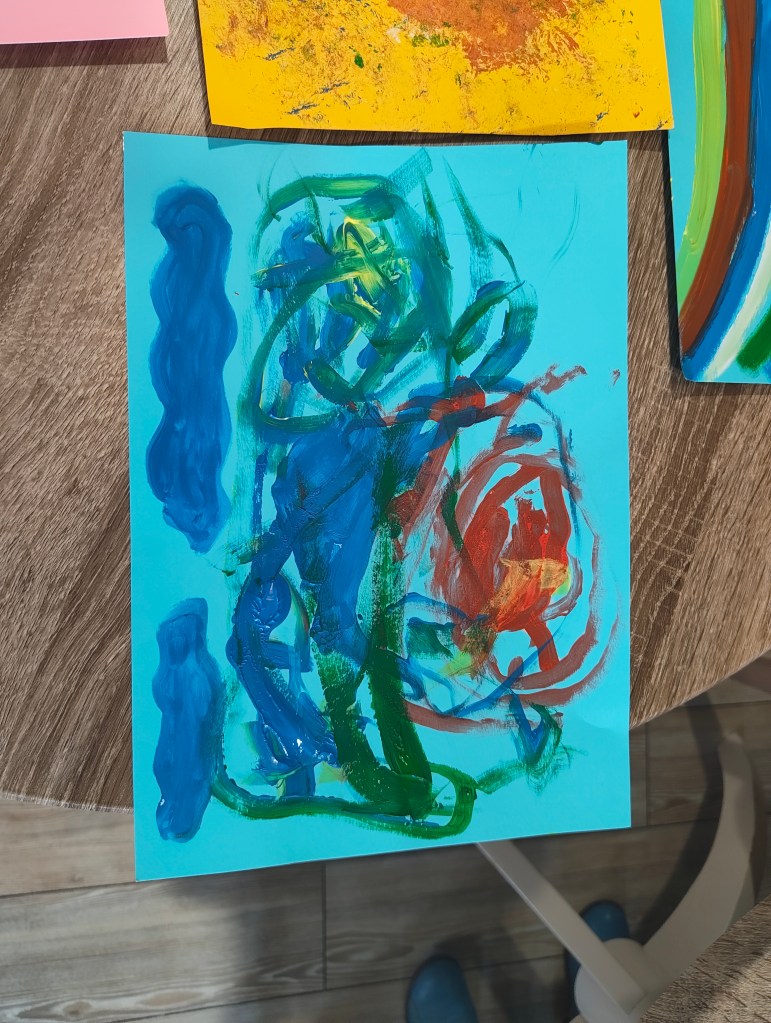
Blog 12 – Music or no music?
Before now, I have run sessions and, in the background, we had music on. It was an interesting experience. Firstly, some people really enjoyed the music – they liked how they could move with the music as they painted. This was really encouraging and made me think that having music could be an interesting facet or element to my practice.
But, if I am being really honest, music not something I personally incorporate into my practice. I think this is primarily because the music must add some kind of level of context to the work being made. For example, if the theme of the workshop is all about nature, I would then think it would be totally appropriate to have recordings of bird song, for example, in the background. I know some people just have music on in the background because it does aid with feelings of being in the moment – but, for me, it must be specific and accurate to what is going on. Maybe this idea stems from years and years of art school education and training where everything has to be context-specific, but I think this is the most relevant way of combining two processes – music and art.
Blog 11
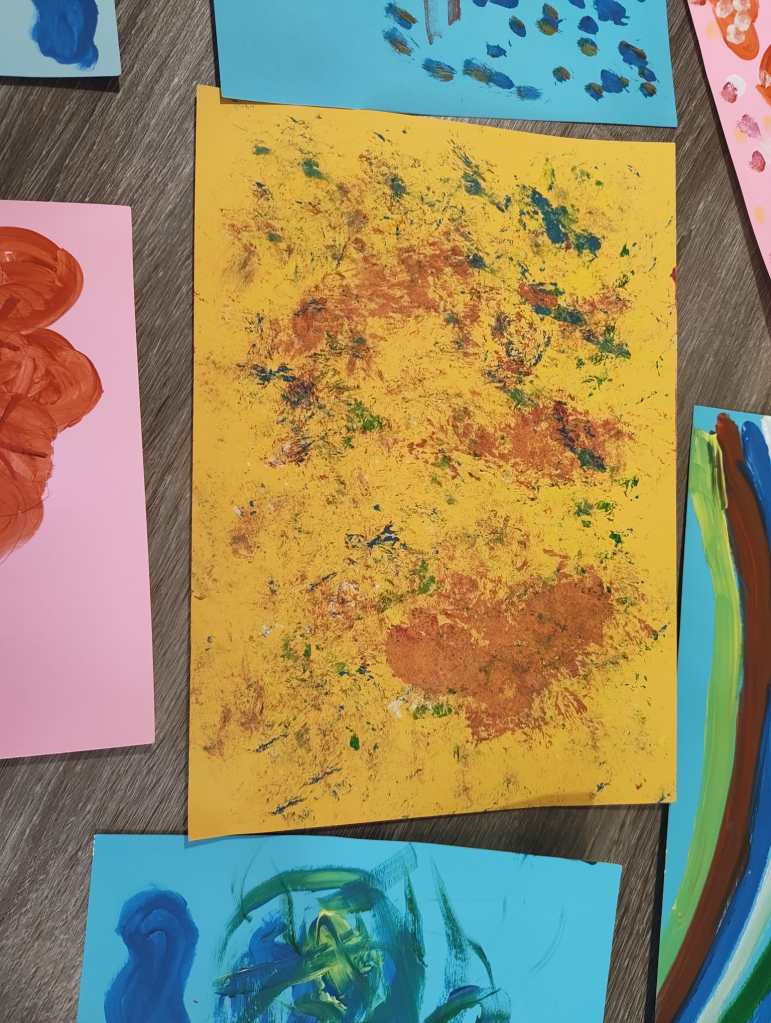
Are acrylics the best paint to use?
I think about this question every time I get set up for an art session. I start thinking maybe today’s session should be a time to explore a new media. But I always resort back to acrylic paints because they are so easy to use. Well, I say that… Acrylic paints behave differently on different substrates, and they are quick to dry. This makes them practical to use.
But when you sit down and paint with them, depending on of course the quality of the paint that you buy, the consistency of the paint can be so… frustrating. I feel like they can be so variable and trying to make this consistent can be so hard. Another issue that you are grappling with too is also the quality of the substrate. I think the most effective way to use acrylics is on either; a very smooth canvas or high-quality paper and avoid mixing with water.
Another question that I get asked often during sessions are: will this come out in the wash!? It doesn’t, unfortunately, but this type of paint does come out, when it is noticed on the wrong surface (like someone’s jumper sleeve) and be blotted out immediately, that usually does the trick!
Blog 10: How is paint applied?
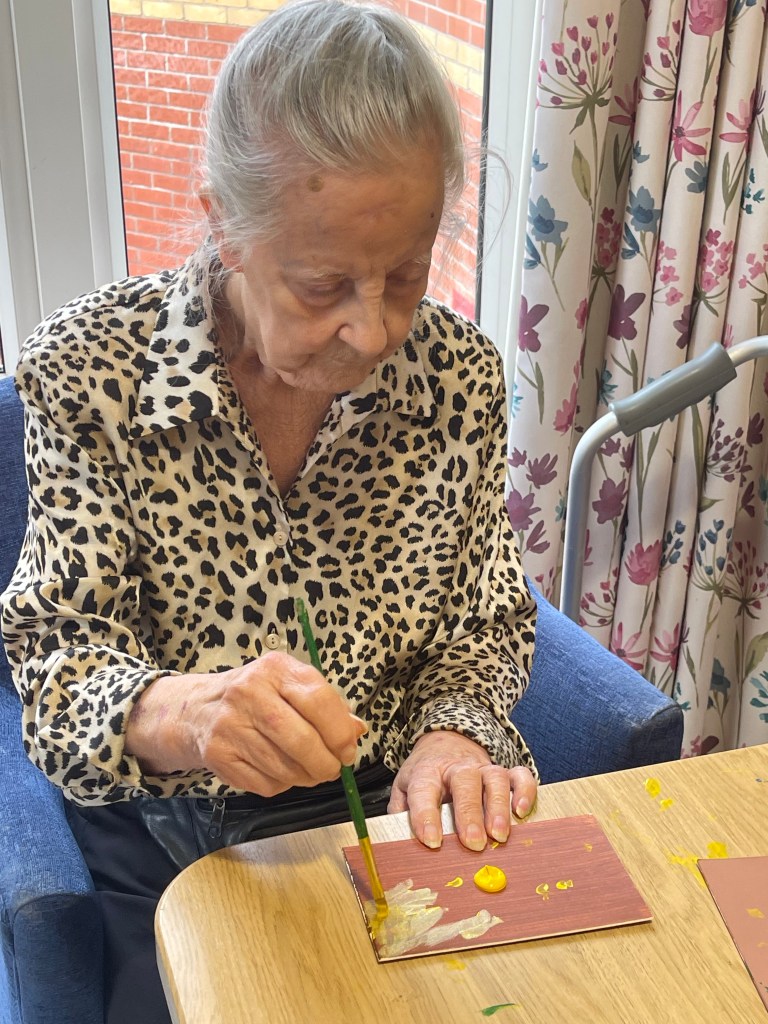
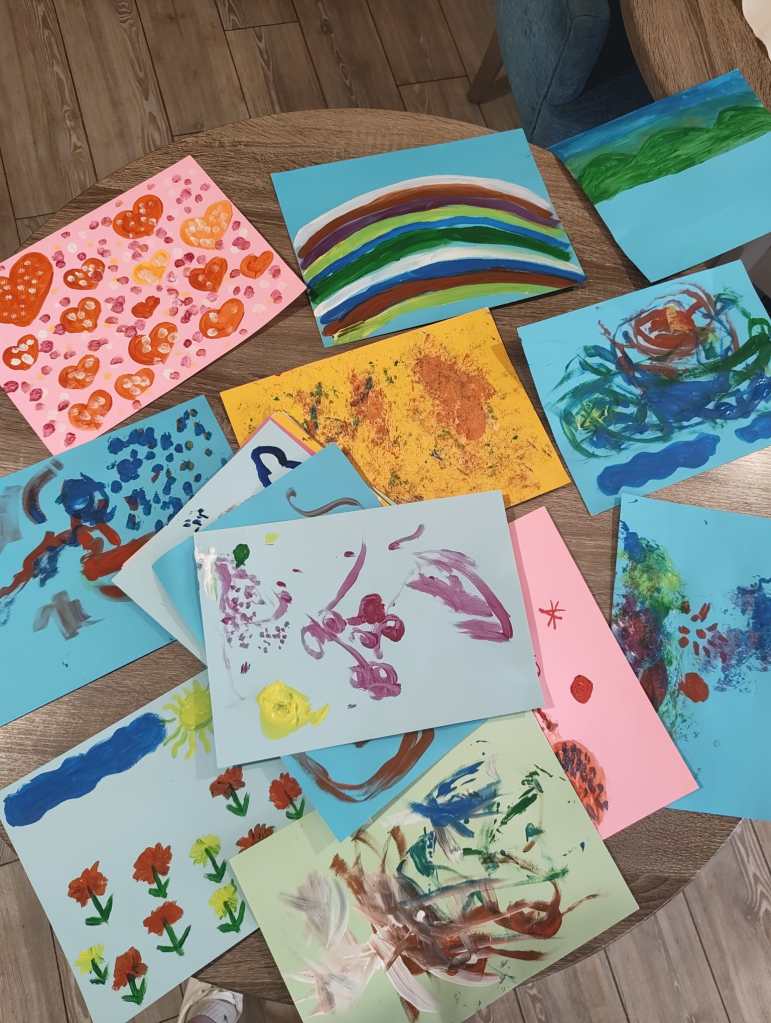
There are so, so many ways in which paint can be applied to any kind of substrate. But this process becomes even more interesting when you are working with someone living with dementia. I have seen PLWD apply paint with their fingers and with the wooden end of a paintbrush, which does create some really interesting marks. Bottom line, this is all about accessibility, and it is down to whatever the person feels most comfortable making. If someone wants to use their fingers, they can. If they don’t but find the end of a brush more interesting, then that is totally fine too. It is all about trying to find new ways of making that are accessible.
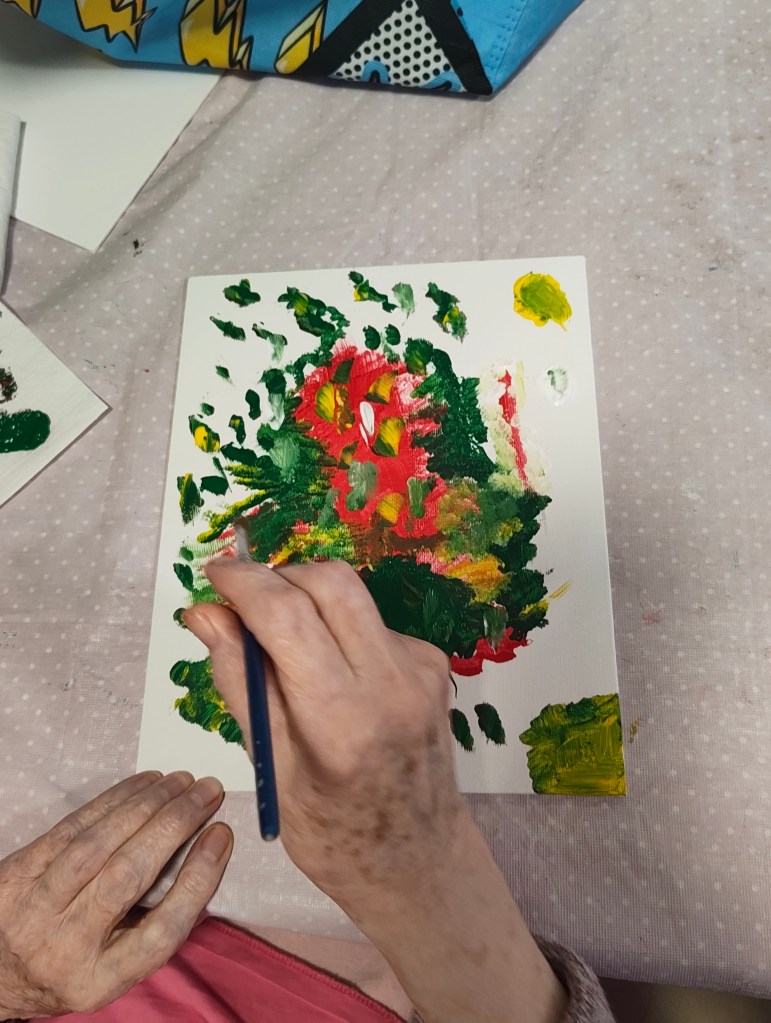
Blog 9: Techniques: Where do you put the paintbrush?
This may seem like such a strange question to ask and attempt to answer – you may be thinking what difference does it makes where on earth a paint brush is placed?!
Well, I have learnt, that over the years, it does make a difference to the person you are working with. For example, when I work with PLWD and they are at the beginning of their dementia journey, it gives the person independence and power if you show them where a brush is and point out where different coloured paints can be found. For example, if you have a wide range of different kinds of brushes, giving someone the choice is important. This helps the person because they can make decisions and feel comfortable and encouraged to choose their own brush, which will impact the overall aesthetics of their artwork. I may use different phrases for this, for example “this brush is really good, this will give you lots of detail”.
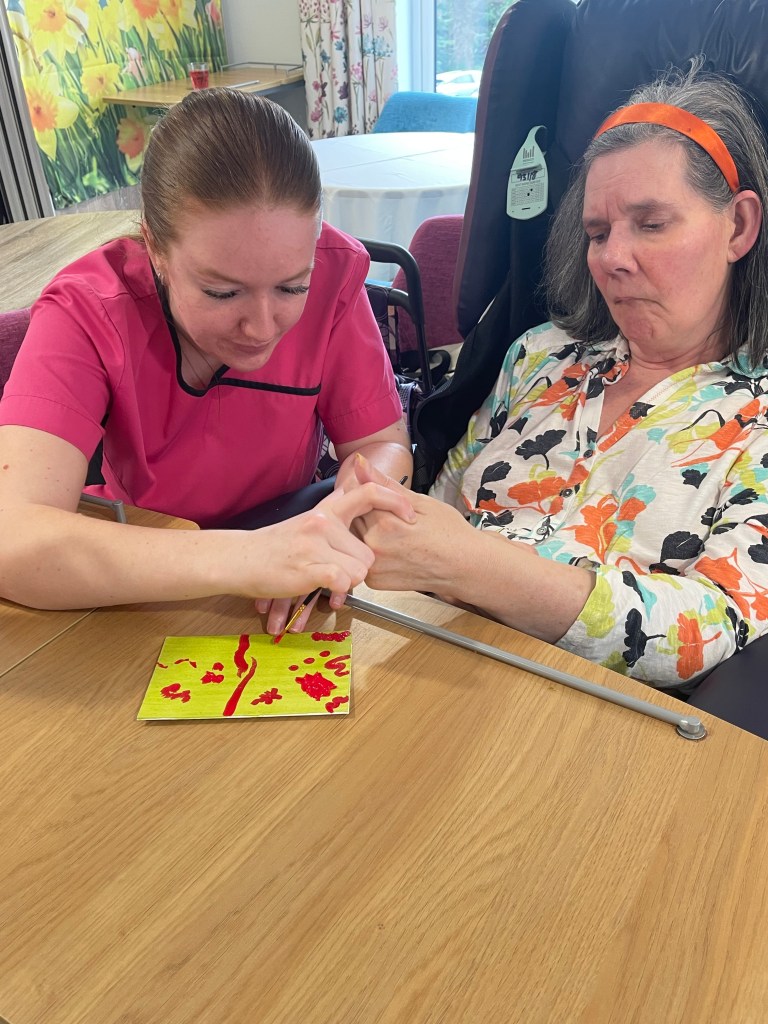
On the other hand, when I am working with someone who is further along in their dementia journey, this is when my process changes a little bit. A lot of it does depend if the person feels confident enough to hold a paintbrush in the first place. Some people may need you to select the brush and then pick up some paint. At that point, you could then just pop the brush down in a place where the person can then pick it up and continue.
Or some other people may need a head start. So, following the same process as mentioned before, I tend to take it a tiny bit further and either do one of two things – load the paintbrush up with paint and then directly hand the brush to the person, or, with the person’s consent, begin the painting and ask them to carry on after a few brush strokes. Usually, my involvement in the making of a painting largely depends on the person’s level of dementia and where they are at with their journey. I like to give people as much space as they need or as much support as they need.
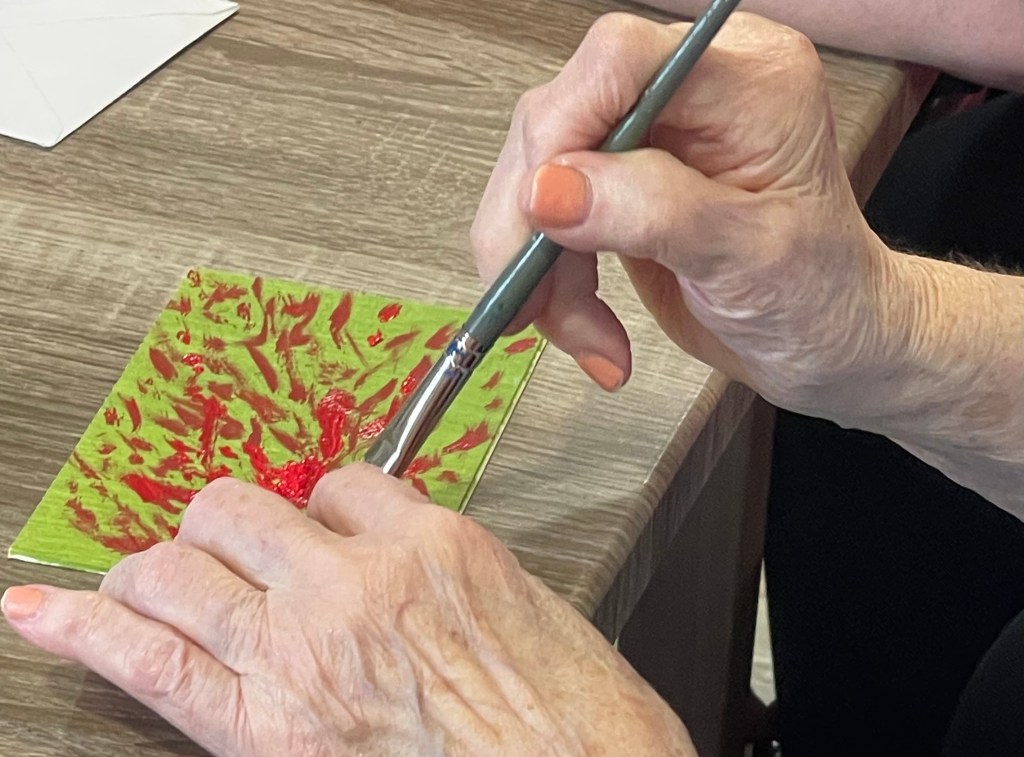
Blog 8 – The way some people living with dementia might feel about art may be so negative because of what they may associate with art
When I work with older adults and I mention that we are going to be doing some art today, I am sometimes met with uneasiness, distress and a sense of “this is not for me and never was for me”.
Which, I do understand. With the aim of not repeating content already discussed on this blog, but this reaction probably stems from beliefs that have been carried from a person’s experience of art during their early school years which may not have been particularly positive or encouraging.
Frequently, I find older adults have this strong, unshakable belief that there is one way of making that is acceptable. They are also adamant that they are locked out from achieving this and cannot see how whatever they make in response to something they enjoy looking at or viewing could ever be seen as “good enough”. I find this element and battle in my practice both sad and frustrating sometimes, but the more sessions I run with PLWD, the more I learn new phrases that help to shift people’s mindsets about what they are making.
Blog -7
Projecting my voice?
Before now, really unfortunately, I have seen older people within care spaces essentially being shouted at when someone is trying to communicate with them. The person is properly shouting, and this experience really stuck with me, because I remember thinking I do not want to communicate with people in this way.
I think some care givers think that this is the best way to communicate with older adults because they sometimes work on the assumption that they cannot be heard. But what I tend to do is just talk in my usual way and start to amplify if it is becoming apparent that I am not being loud enough.
Although I still do find this uncomfortable!
Blog 6
The use of written language during a painting workshop
Sometimes, when PLWD takes part in one of my workshops, they will use language instead of mark making from their imagination or from what is around them. I have found this, over the years, really interesting, and it has made me curious, because text is such a predictable way of making marks onto a substrate.
I have realised that one reason for why PLWD may do this is because words, for example, have a very predictable form and you know deep down that you cannot really go wrong, because the form of the words and the “what to do” is readily available. Whereas, on the other hand, mark making is the total opposite; it asks someone to rely on their imagination in whatever form that takes, which I think for some people, can find that daunting. This is because there is an element of fear attached to what can go wrong in art, which is such a shame, because really, there is no wrong in art, but so many older adults think that there is and that there is “good” and “bad” art. Good art is where whatever is on the canvas, for example, resembles something of real life and something that can be easily recognised and distinguished; whereas bad art is where none of this can be registered. There is a higher level of ambiguity which I think really concerns some people, because the interpretation is so open and there is a chance they could get it wrong so that their idea will be dismissed because it is perceived as being “silly”.
So, therefore, this is why I feel I have observed a few different PLWD leaning into writing. It offers a predicable and clean way of responding to the task, which is fascinating. A lot of my time is spent during a session trying to convince those that this is a good way of making but then working with other lines and colours to embrace this part of the activity in question.
Blog 5
Meeting someone living with dementia where they are at
Throughout many of my different commissioned project working with PLWD, I have worked with people in public spaces, for example the living rooms of a care home and the main meeting room at a Meeting Centre.
These are spaces that are comfortable and designed to seat and look after multiple people with various caring needs. It is a place where people can come together, share ideas, discuss thoughts and feeling and watch TV together.
I have also worked with PLWD in their personal living rooms at home. This was an interesting experience I had, and this became a part of my practice during 2022. I really liked it, but it felt so different. It was so helpful to be surrounded by the person’s objects, photographs and other general memorabilia. It meant that as an artist who were immersed in someone else’s space, and you could feel inspired, as you were objective in the space.
But more recently, I have gained experience working with PLWD who were confined to their bedrooms due to extreme immobility, which was a really astounding experience. It gave me goosebumps for different reasons. It made my work so rewarding in more ways than one, and it was hard to explain why to begin with when I first started reflecting on my experience.
In one care home, I was asked to work with a lady who couldn’t access the main room because of mobility issues. She had spent her working life working with young people and art, and her bedroom walls were populated with artworks she had created over the years.
She started to paint and I listened carefully to everything we said. What was quite amazing was how we were, in the most literal sense, meeting her exactly where she was at – she couldn’t make it into the main room, so we went to see her, with a massive 40” x 30” canvas. We propped it up against a small table that we could make vertical with a small ledge to rest the canvas on.
So, the lady was still able to take part, even though she could not move. It was an incredible experience and one I hope to do a lot more.
Blog 4
The relatable relationship between feelings of frustration, dementia and art
Drawing from my own lived experience: recently, I tried to paint an idea I had in my head relating to a personal theme that I wanted to communicate, and I had been generating it in my head for a while. But when I finally got around to painting it, and it did not turn out the way in which I wanted it to, I got so frustrated because what I had made did not match up to what I had in my head. Even when I tried to lean into what I had made and tried to like it, I then was not inclined to work on the canvas again. It was so hard.
I then tried to tap into the idea of mark making and the idea that, the outcome doesn’t matter. But I got so frustrated because I wanted to do something so specific to communicate a very specific idea.
So, I then imagined that if I had dementia, this feeling must be…. Pretty frustrating and not fun in the slightest.
First, PLWD may not be able to do what they want because they feel they don’t have the skills. This may stem from negative associations from art lessons back when they were at school.
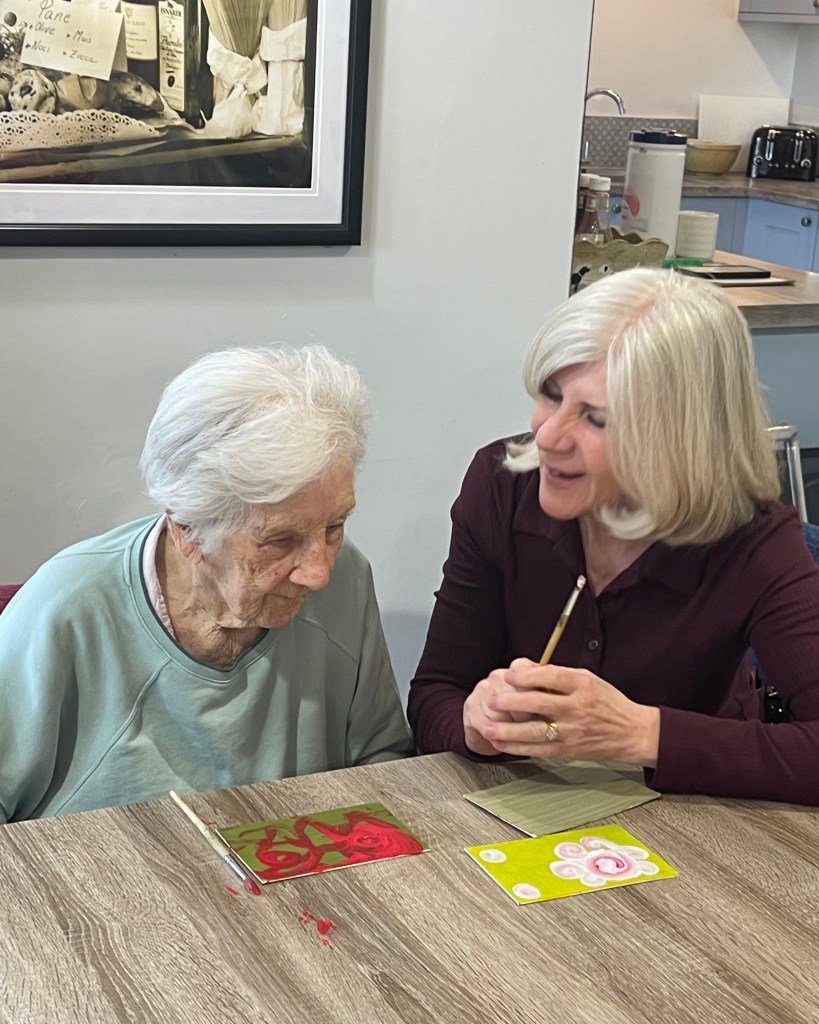
Then, the person is dealing with the fact that their brain is not working the way it used to, and ideas do not come out the way you intended or wanted them to. This really has changed the way I think about doing my socially engaged art practice because it has made me aware that there may be so many different feelings at play when people living with dementia take part in art activities and what they may be carrying into the session.
Blog 3
What is co-creation in dementia and art? This week I have cheated a little bit, but this is a blog on a project that I have been involved in https://blogs.ed.ac.uk/ecred/2025/11/12/imagined-reflections-from-our-coproduction-group/
Here is a little snippet of what I have written.
I have thoroughly enjoyed being a part of the IMAGINED project, which stands for Investigating Meaning-making and the cocreation of Guidelines for Evaluation IN participatory Arts for Dementia. When I first came across the opportunity to be a part of this coproduction group, I was immediately excited because it was an opportunity to explore two ideas that I am really passionate about – dementia and art. I was also intrigued by the connecting factor in these two topics, which is meaning-making.
Ironically, I think meaning-making can be left out of the equation when it comes to dementia and art. This can be frustrating because there can be so much meaning represented through work created by PLWD. Within the context of care, I think art can sometimes be perceived as an opportunity to distract people living with dementia for a little while, which is not the sole purpose of art making…. it is so much more! Art can sometimes be seen as just “something to do”, to fill space and time, which is a limited/black and white/deterministic perspective.
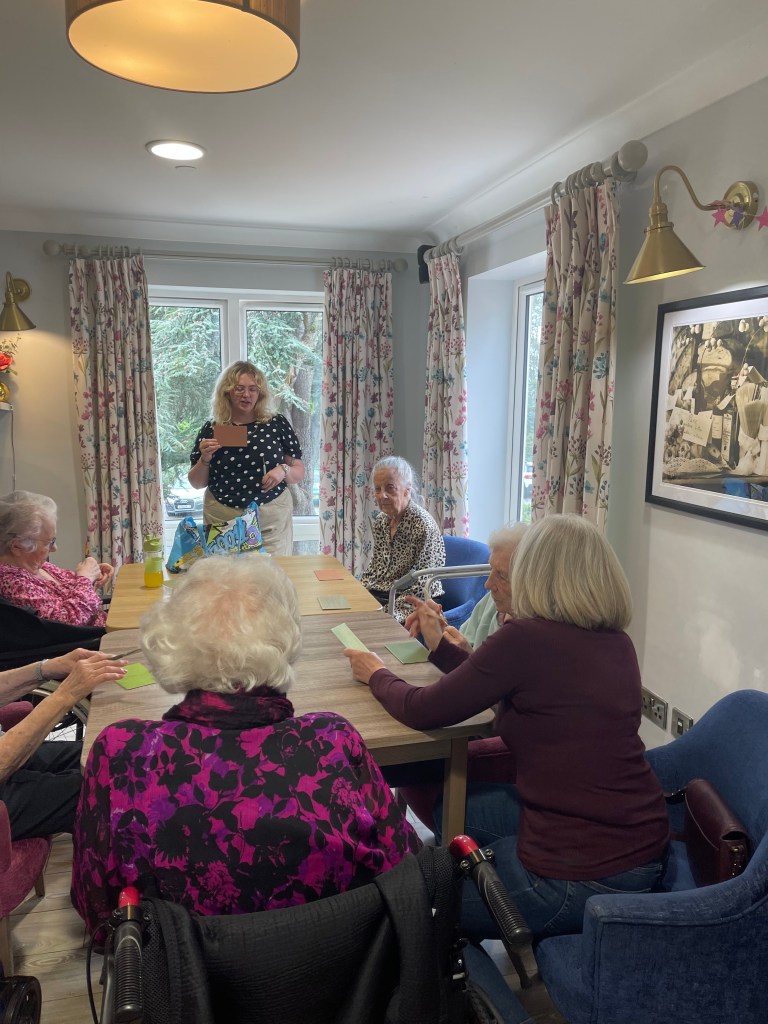
I have really enjoyed contributing to the discussions around these ideas. Recently, we talked about what it means to really place an emphasis on value and meaning for people living with dementia and what this might look like.
Blog 2
How did I first start to work with PLWD?
I recall being in the midst of the third year of my undergraduate degree in Fine Art, and I couldn’t help thinking about what I was going to do next in terms of my art career and how I could continue to make art in a real and sustained way with some benefit to society. I knew I was going to do my MA, which I did do, but I wanted to be paid for my work as a practitioner too. My mind has always worked like that – thinking ahead to the future and wondering how I was going to get there!
I was just randomly researching “art jobs in the West Midlands”, and I saw a page called Heritage Pathfinders, and that is how my journey into exploring the relationship between dementia and art began back in 2021.
However, in 2015, I had the experience of working in care homes and just talking about art in those spaces, although I didn’t make back then in those sessions, I was there to gain experience, but I couldn’t help thinking further about art and how it could work in an environment like a care home. I was drawn to learning about other people’s life experiences and how this could be represented in some way.
Fast forward to 2021, the Heritage Pathfinders Project was a project that led to pilot sessions and exploration of how marks can enable PLWD to make meaning of themselves and the wider world. There were 12 pathfinders, and we met up on a regular basis to chat through what ideas we had, what we were thinking of doing for our projects, and we had an amazing coordinator who would help us with organising time in a meeting centre to deliver our projects. Looking back, we were so lucky to have someone organising that side of the project in that way, as since freelancing, this can be quite chaotic!
During my first project, there was a big movement from representational to abstract art. I first started thinking about my project through the lens of “let’s draw a cat, mouse, house, anything!” but slowly, as the project moved on, I started to work more abstractly, and we started to think increasingly about mark making and what this could mean for PLWD.
Blog 1
Hello everyone! Thank you so much for taking the time to find my blog and maybe giving it a read. This is something I have been meaning to do for some time, and it reflects the work that I do with people living with dementia as a socially engaged artist practitioner. The blog will be updated each week/as and when.
The blog covers all sorts of different ideas that you may find interesting if you want to find out more about what it is like to work as an artist with people living with dementia. We look over themes such as clock-face drawings, relational aesthetics, the purpose of different kinds of textures, how mark making is often a defiance of what people living with dementia can make and do, and how marks can be linked with different emotions and feelings. There are also some other general practical bits to do with how to set up a session, and considering how important a plan is.
There is one short key code – PLWD – People/person living with dementia. I am also aware that the language around describing people living with dementia is constantly changing and developing, but at the time of writing (April 2026) PLWD is the go-to.
Disclaimer: PLEASE DO NOT interpret my writing as training, as these are just personal reflections of different bits that I have learnt over the years that I would like to share, as I feel they might be interesting and helpful for others. If you would like to know more about my art practice, please do not hesitate to get in touch.